How to Choose the Right Slewing Bearing for Your Project?
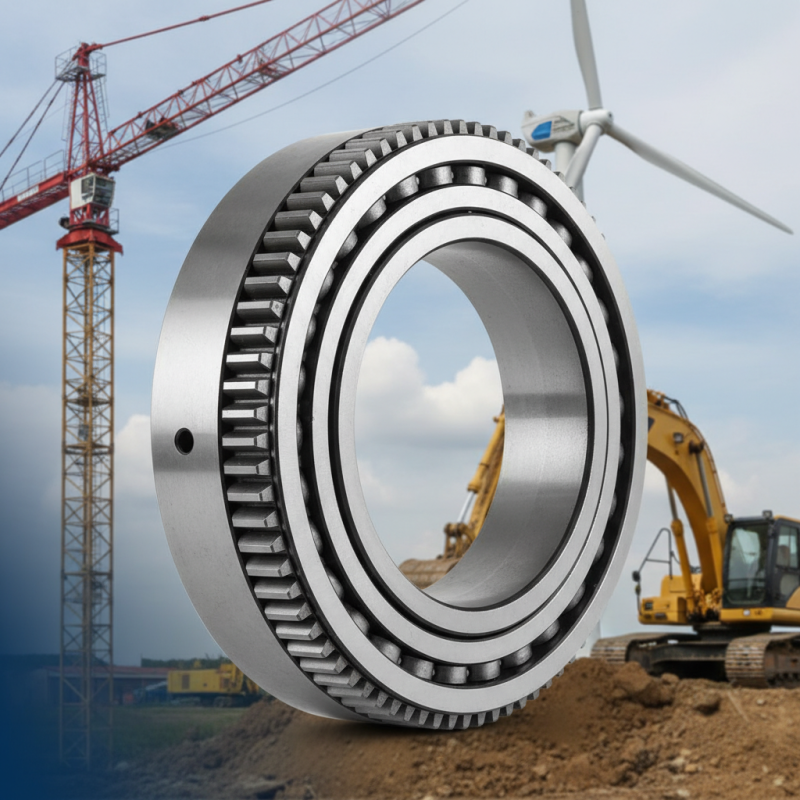
Choosing the right slewing bearing for your project is crucial. This component plays a vital role in various applications, like cranes, wind turbines, and excavators. A suitable slewing bearing ensures proper load distribution and smooth rotation, enhancing overall efficiency.
When selecting a slewing bearing, consider several factors. Material, size, and load capacity are essential. Each project has unique requirements, and overlooking them can lead to problems. Size compatibility is especially critical. Too big or too small can hinder performance.
Another issue is misjudging the operational conditions. For instance, extreme temperatures or heavy loads may demand specific types of bearings. Remember, a well-chosen slewing bearing improves productivity. An improper choice can lead to costly repairs or downtime. Reflect on these aspects as you embark on your selection journey.
Understanding Slewing Bearings and Their Applications
Slewing bearings play a crucial role in various industries. They are essential components for heavy machinery, cranes, and wind turbines. Recent data shows that the global slewing bearing market is expected to reach $3.5 billion by 2026, driven by increased demand for construction and renewable energy projects. This growth highlights the importance of understanding the right type of slewing bearing for your application.
Different applications require different types of slewing bearings. For instance, in the construction industry, cross-roller slewing bearings are popular for their high load capacity and compact design. In contrast, gear-driven slewing bearings are preferred for cranes, allowing precise movement. A study indicates that improper bearing selection can reduce operational efficiency by up to 30%. Failing to consider factors like load, speed, and environmental conditions can lead to costly downtime.
However, the industry still faces challenges. Bearing failures often stem from inadequate maintenance or misalignment during installation. According to reports, nearly 15% of all bearing failures are due to human error. This emphasizes the need for careful selection and ongoing training for operators. Investing in proper training and maintenance can pay off significantly in the long run.
Key Factors to Consider When Choosing a Slewing Bearing
Choosing the right slewing bearing for your project is crucial. Several key factors can guide your decision. Start by considering the load capacity. Assess the maximum weight the bearing will support during operation. If it’s insufficient, you risk failure. Pay attention to the outer and inner diameters as well. They should fit your machinery perfectly.
Next, think about the environment in which the bearing will operate. For high temperatures or exposure to moisture, choose materials that withstand these conditions. Consider lubrication needs as well. Optimal lubrication improves performance and extends the bearing's lifespan.
Tips: Before finalizing your choice, consult professionals. They can provide insights into specific applications. Additionally, review installation requirements. A poor install can lead to early wear or damages. Don't overlook this step. It's often the most ignored yet vital part of the process. An easy mistake is assuming all bearings are the same. This could be costly in the long run.
Comparative Analysis of Key Factors for Choosing Slewing Bearings
Types of Slewing Bearings: A Comprehensive Overview
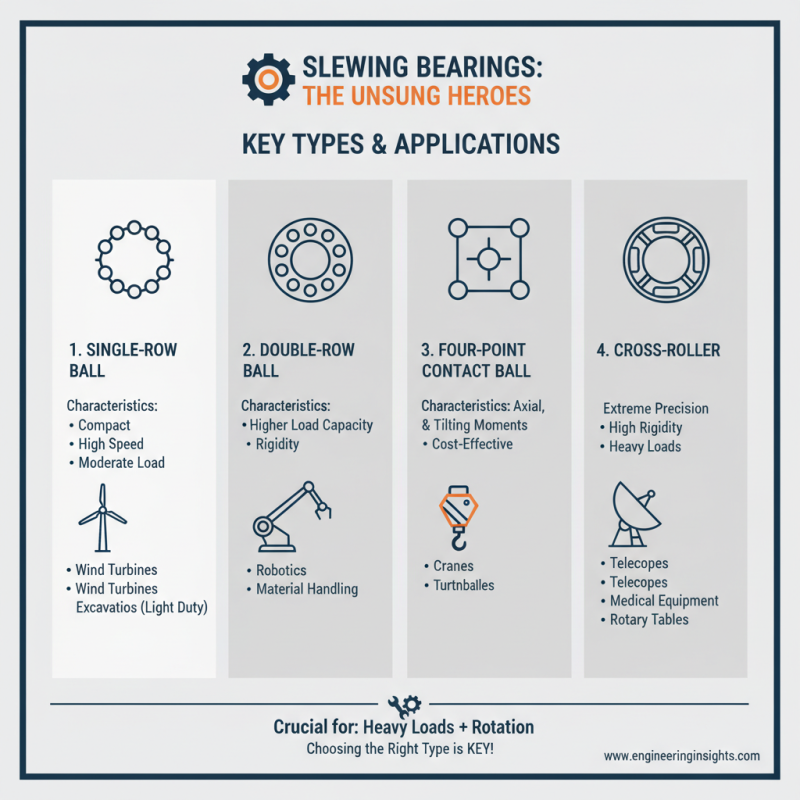
Slewing bearings play a crucial role in various engineering applications. They support heavy loads while allowing rotational movement. There are several types of slewing bearings, each suited for specific tasks. The design and dimensions vary significantly among them. This diversity can complicate the selection process.
The most common types include single-row ball bearings, double-row ball bearings, and roller slewing bearings. According to industry data from a recent market analysis, single-row ball bearings are widely used due to their simplicity and compact design. They can handle axial and radial loads effectively. In contrast, double-row ball bearings provide enhanced load capacity, especially in larger applications.
Roller slewing bearings are ideal for heavy machinery. They offer better stiffness and load distribution. However, they can be more complex and costly. A detailed comparison is necessary when selecting the right type. Each option has its strengths and weaknesses. Many designers spend too much time choosing without fully understanding their application needs. A thoughtful approach can lead to better project outcomes.
Evaluating Load Capacity and Performance Requirements
When selecting a slewing bearing, understanding load capacity is crucial. Load capacity defines how much weight the bearing can support safely. The typical load capacities range widely. For instance, small bearings may support around 10 kN, while larger ones can handle over 1,000 kN. These figures indicate the importance of proper evaluation when choosing a bearing for heavy machinery projects.
Performance requirements also play a vital role. The operational speed, environmental conditions, and expected lifespan are key factors. For example, in construction machinery, bearings should withstand not only static loads but also dynamic loads that may arise during operation. Reports show that bearings in harsh environments can experience a reduction in lifespan by up to 40%. This statistic highlights the need for careful analysis.
It’s essential to assess the intended application thoroughly. Overestimating or underestimating load requirements can lead to failures. Many projects fail due to this miscalculation. Reflecting on past projects, it's clear that selecting the correct bearing involves a balance between ideal specifications and practical limits. This careful consideration can prevent costly downtime and ensure project success.
Maintenance Tips for Prolonging the Life of Slewing Bearings
Slewing bearings are essential for many heavy machinery applications. Proper maintenance can significantly extend their lifespan. Studies show that regular inspections can reduce failure rates by 30%. It’s crucial to monitor lubrication levels. Insufficient lubrication can lead to wear and overheating.
Cleaning is another vital aspect of maintenance. Dirt accumulation around the bearing can cause corrosion. The best practice is to clean them at least every six months. High-pressure washing can help but be careful with the angle and distance. A study from the Machinery Reliability Council indicates that 25% of bearing failures could be avoided with better cleaning protocols.
Inspection routines should not be overlooked. Look for abnormal sounds or vibrations. These indicators can signify deeper issues. If an imbalance is detected, recalibration may be necessary. Keeping records of performance metrics can help identify trends. Maintenance might seem simple, yet it often gets neglected, leading to unforeseen downtime. Making maintenance a habit can yield lasting benefits.

 +86-13349293098
 Contact WhatsApp
 Contact Email