+86-13349293098


Choosing China’s best Twist Cylinder supplier requires more than comparing prices, photographs, or attractive catalogues. The right decision begins with your operating conditions. Consider load capacity, twisting frequency, installation space, working temperature, corrosion exposure, and required service life. A cylinder used near saltwater needs different seals and surface protection than one installed inside a clean factory.
Dr. Elena Marquez, a hydraulic systems engineer with more than twenty years of field experience, says, “A dependable cylinder starts with the application, not the catalogue.” Her point is practical. A serious supplier should ask for drawings, pressure data, duty cycles, and connection details before recommending a model. Be cautious when a salesperson promises immediate compatibility without requesting measurements.
Look closely at manufacturing evidence. Ask about steel grades, piston-rod treatment, sealing brands, welding procedures, dimensional inspection, and pressure testing. Request test reports and sample photographs. Better suppliers can explain their quality process clearly. They should also provide traceable batch records and replacement-seal support.
Small details matter.
During supplier evaluation, compare communication speed, engineering feedback, packaging quality, and after-sales response. A strong factory may offer customization, but customization without documented testing creates risk. We should admit one limitation: online audits cannot reveal every production problem. A pre-production sample and independent inspection remain valuable.
The best China Twist Cylinder supplier is not always the cheapest option. It is the partner that understands your equipment, documents its claims, and delivers consistent performance. This guide examines those selection points carefully, while recognizing that every application has unresolved variables.
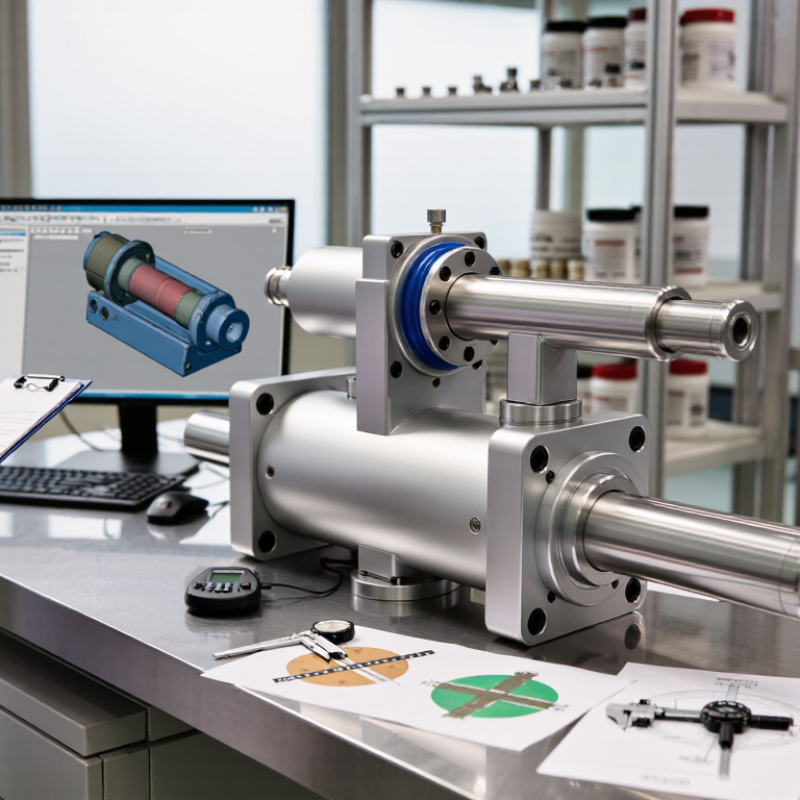
A twist cylinder converts pneumatic linear motion into controlled rotation. It suits gripping, indexing, clamping, and light turning tasks. Common designs include rack-and-pinion, vane, and helical mechanisms. Each type produces different angles, backlash, speed, and maintenance needs.
Rack-and-pinion models often offer clear torque selection and adjustable rotation. Vane units can be compact, but seal wear may affect performance. Helical designs provide smooth motion, although their internal structure can be harder to inspect.
Keep the application concrete: a 90-degree fixture turn is not the same as continuous shaft rotation.
Torque ratings need careful interpretation. Manufacturers may list theoretical torque without load friction, acceleration, or safety margin. Calculate payload force, arm length, start-up resistance, and stopping impact.
Then apply a practical margin, often 25 to 50 percent, according to duty conditions. A 10 N force acting at 0.2 meters requires 2 Nm before losses.
That is only a starting point. Mounting direction matters too. Vertical loads can demand more torque than a catalog example suggests.
In field reviews, selections often fail because users compare numbers without checking air pressure.
ISO 15552 compatibility mainly concerns pneumatic cylinder dimensions, mounting interfaces, and accessory interchangeability. It does not automatically confirm twist-cylinder performance.
Check bore, port size, shaft geometry, sensor position, and operating pressure. Confirm the drawing, tolerance, and test method.
Ask for real cycle data. A supplier should explain rated torque at your pressure, not only publish a large headline figure.
Some specifications remain unclear. Challenge them before approval.
When selecting a twist cylinder supplier in China, start with operating pressure, not catalog claims. Many units list 0.1–1.0 MPa, but your machine may use only 0.4 MPa. Confirm the minimum starting pressure, maximum working pressure, and pressure fluctuations. Ask for test records and seal compatibility data. That evidence matters. A pressure gauge near the cylinder can reveal unstable supply conditions.
Bore size controls force and air consumption. For a pneumatic unit, estimate force from pressure and effective piston area. Then allow margin for friction, load changes, and imperfect alignment. A bore that looks economical can stall under a cold, sticky load. Do not size it by outside diameter alone. Stroke must match the real twisting distance. Measure the tool position at both ends, including fixtures and elastic movement. If the stroke is too short, the workpiece may not release completely. If it is too long, cycle time and impact can increase.
Cycle requirements deserve equal attention. Record cycles per minute, duty hours, dwell time, and expected service life. Ask whether the supplier tested the cylinder under similar frequency and load. Heat, moisture, and contaminated air can change performance. These details are often overlooked. A practical mistake is trusting a nominal pressure range without checking response at 0.1 MPa. I have seen sizing decisions fail because the bore was correct, but the cycle rate was not. Recheck every assumption before approving the drawing.
China Best Twist Cylinder Supplier: How to Choose?
When comparing China twist cylinder suppliers, ISO 9001 is a useful starting point. It shows that the supplier follows a controlled quality management process. However, it does not prove that every cylinder performs perfectly. Ask for the certificate number, issuing body, scope, and validity date. The scope should cover relevant manufacturing activities. Check whether the certificate matches the factory’s legal name and address.
CE certification also needs careful review. A genuine CE assessment should connect the product with applicable European requirements. Request the EU Declaration of Conformity, technical file summary, and related test evidence. The model number, materials, pressure range, and safety details should match your purchase. A copied document may look professional. It may still describe another product. This is where buyers often make mistakes.
Tips: Request recent test reports from an independent laboratory. Confirm the laboratory name, accreditation, test standard, sample description, and report date. Ask for production samples before placing a large order. Measure thread accuracy, surface finish, sealing performance, and rotation smoothness. Keep photos and inspection records. Small details matter.
In practical sourcing, certificates are only evidence, not a guarantee. One overlooked model suffix can create serious confusion. Supplier answers should be specific, consistent, and easy to verify. Reliable manufacturers usually explain limitations instead of promising perfect results. That honesty is valuable.
| Evaluation Dimension | Relevant Standard or Requirement | Evidence to Request from a Supplier | How to Verify It | Recommended Decision |
|---|---|---|---|---|
| Quality management system | ISO 9001:2015 | A current ISO 9001 certificate showing the legal manufacturing site, certification scope, certificate number, issue date, expiry date, and certification body. | Check the certificate directly in the certification body's online directory or confirm it with the issuing body. | Treat a valid certificate as evidence of a documented quality system, not as proof that every cylinder design is suitable. |
| Product conformity | CE requirements depend on the final machine, application, and applicable European legislation. | A Declaration of Conformity identifying the product, applicable legislation, relevant standards, manufacturer, authorized signatory, and date. | Confirm that the declaration covers the supplied configuration and does not rely only on a generic “CE certificate.” | Request a technical explanation when CE marking is claimed for a standalone hydraulic cylinder, because CE is not automatically required for every cylinder. |
| Hydraulic cylinder acceptance testing | ISO 10100:2018, where applicable | A product-specific test report covering leakage, operating performance, dimensional checks, and pressure-test results. | Check the report number, test date, cylinder serial number, test medium, test pressure, holding time, measured results, and approval signature. | Prefer reports linked to the actual production batch or cylinder serial number rather than undated sample templates. |
| Design and mounting dimensions | ISO 6020/2 or ISO 6022, when the cylinder design follows these series | A controlled technical drawing showing bore, rod diameter, stroke, mounting type, port size, retracted length, extended length, and tolerance information. | Compare the drawing with the purchaser’s installation envelope and request revision-controlled documents. | Reject quotations based only on nominal bore and stroke when mounting dimensions or tolerances are not confirmed. |
| Rated pressure and proof pressure | Declared by the manufacturer and verified against the application design requirements | A datasheet stating rated pressure, maximum permissible pressure, proof-test pressure, operating temperature range, and hydraulic-fluid compatibility. | Check that the values are consistent across the quotation, drawing, datasheet, and test report. | Do not compare suppliers using pressure figures alone; verify duty cycle, side-load limitations, speed, and mounting conditions. |
| Material traceability | EN 10204 inspection documents, such as type 3.1, when specified by contract | Material certificates for the barrel, piston rod, piston, and critical welded parts, including heat or batch numbers. | Match material certificate numbers with incoming inspection records and production batch records. | Give higher preference to suppliers that can trace critical materials from purchase through final inspection. |
| Welding and inspection control | Applicable welding procedures, personnel qualifications, and inspection requirements for the cylinder design | Welding procedure records, welder qualification evidence, visual inspection records, and non-destructive testing reports when specified. | Confirm that the documents identify the component, inspection method, acceptance criteria, date, and responsible inspector. | Require additional inspection for high-pressure, fatigue-critical, or safety-related applications. |
| Seal and hydraulic-fluid compatibility | Compatibility must be confirmed for the specified fluid, temperature, pressure, and speed. | Seal material, seal manufacturer specification, temperature range, fluid type, and recommended service limitations. | Compare the seal specification with the hydraulic-fluid supplier’s compatibility guidance and the machine operating conditions. | Avoid accepting “standard seals” without identifying the material and operating range. |
| Final inspection and traceability | Supplier-defined inspection plan aligned with the approved drawing and purchase specification | Final inspection report covering dimensions, surface condition, leakage, pressure testing, paint or coating, identification, and packaging. | Verify that acceptance criteria are stated and that the report references the actual order, batch, or serial number. | Select suppliers that provide objective records instead of a simple “passed” statement. |
| Technical support and corrective action | Documented complaint handling, root-cause analysis, and corrective-action process | Warranty terms, response-time commitment, replacement policy, non-conformance report template, and corrective-action procedure. | Review the service terms before ordering and request an example of a redacted corrective-action report. | Prefer suppliers that define responsibilities, response times, and evidence requirements in writing. |
Selection rule: A reliable twist cylinder supplier should provide verifiable quality-system documentation, application-specific technical data, traceable test records, and a clear conformity explanation. ISO 9001, CE documentation, and test reports should be evaluated together rather than treated as interchangeable proof of product quality.
Choosing a twist cylinder supplier starts with the working environment, not a glossy catalog. During field inspections, I check material certificates, surface treatment, and corrosion resistance. Stainless steel may suit humid equipment, while hardened alloy steel can handle heavier torsion. The wrong material may survive installation but fail under repeated movement. That mistake is expensive.
Seals deserve equal attention. Ask whether the sealing compound matches temperature, oil exposure, and operating pressure. A cylinder can lose pressure through a seal before its metal body shows damage. Inspectors should also review CNC tolerance reports for bore size, shaft alignment, and thread accuracy. Request actual measurement records, not vague claims of precision. Small deviations can create uneven loads and premature wear.
A claimed one-million-cycle life needs clear test conditions. Request the test speed, load, rotation angle, lubrication method, and temperature range. A reliable endurance report should show leakage results, torque changes, and inspection intervals. Independent or witnessed testing adds credibility. Still, laboratory cycles are not a factory floor. Misalignment, side loads, and sudden impacts can shorten service life. I have seen excellent prototypes fail after installation because mounting accuracy was ignored. Leave room for doubt. Choose a supplier willing to discuss failures, provide traceable samples, and explain what the test does not prove.
Use these reference benchmarks when evaluating a twist cylinder supplier: verify at least 1,000,000 operating cycles, confirm the rated pressure against the required ISO cylinder class, request documented CNC inspection results around ±0.02 mm, and check that the seal compound is suitable for the intended temperature range. Values are procurement reference targets rather than universal requirements.
Choosing a China-based twist cylinder supplier requires more than comparing unit prices. MOQ affects cash flow, storage, and replacement flexibility. A low MOQ is useful for testing, but repeated small orders may increase freight costs. Request a pilot batch and record actual defect rates. My experience suggests that written lead-time commitments matter more than attractive quotations. McKinsey’s 2022 supply-chain research reported that 72% of companies faced major supply disruptions, so include production and shipping buffers.
Warranty terms should specify coverage, cycle limits, seals, and response time. “Twelve months” sounds reassuring, but it may exclude wear parts or improper installation. Ask for inspection records, material certificates, and failure-analysis procedures. ISO 4414 emphasizes safe pneumatic-system design, yet compliance alone does not guarantee long service life. That distinction is easy to miss.
Calculate total cost per operating cycle, not purchase price alone. Use this formula: purchase cost, freight, installation, energy, maintenance, downtime, and disposal, divided by verified cycles. The U.S. Department of Energy reports that compressed-air leaks can waste 20–30% of compressor output. Poor sealing can therefore erase a cheap quotation quickly.
For example, a cylinder costing 80 dollars but lasting 400,000 cycles costs less per cycle than a 55-dollar unit lasting 150,000 cycles. These figures are illustrative, not promises. Ask suppliers for endurance-test conditions, because laboratory cycles rarely match dusty factory floors.